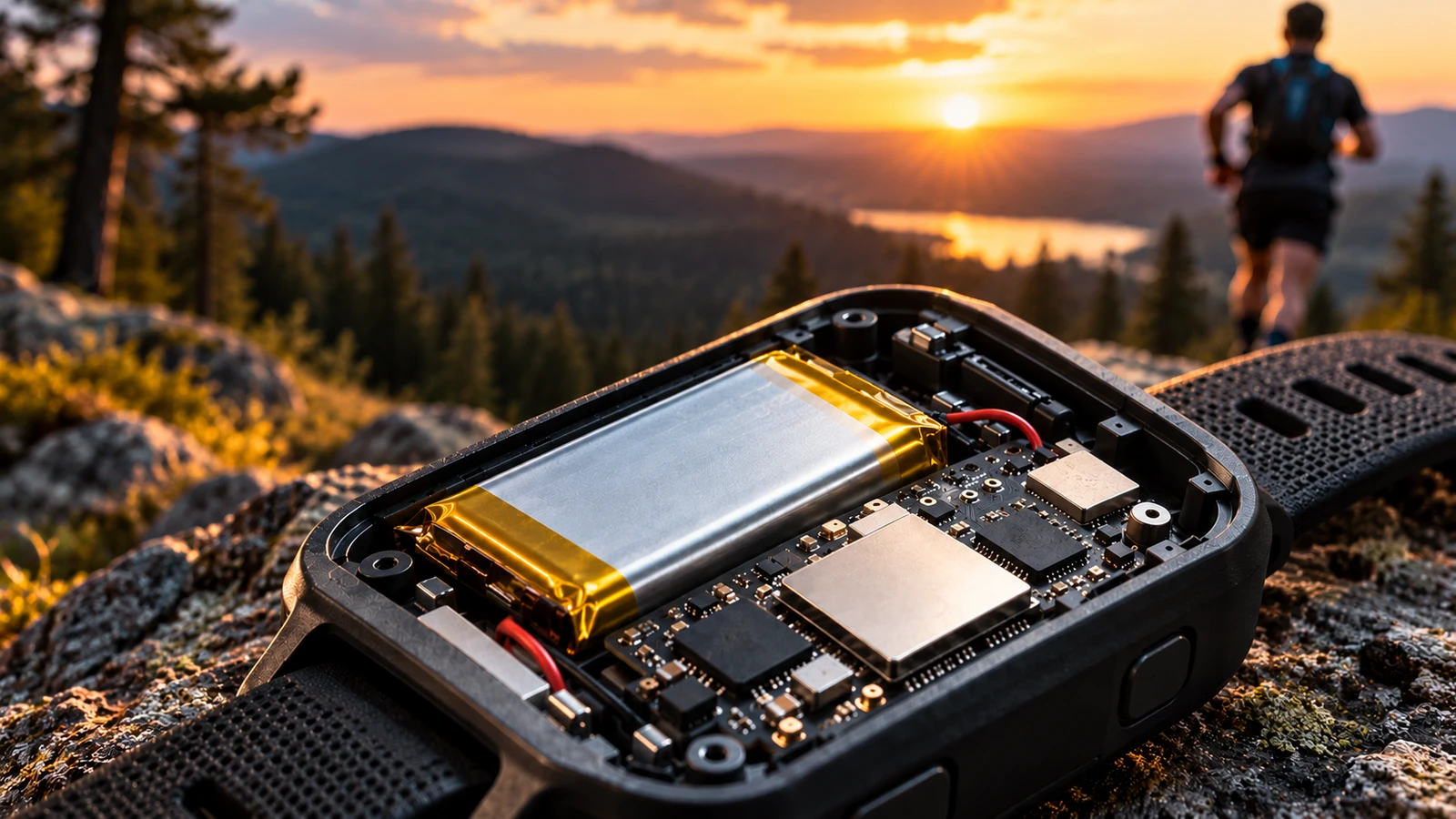
When developing a sports GPS tracker, battery capacity is only one factor determining how long and how reliably the device operates. Equally important is how efficiently the device manages power consumption and handles short periods of high electrical demand.
At Sport Flow Solutions, we are developing our own wearable GPS tracker for real-time athlete tracking. One of our key engineering priorities is creating a reliable power system that can support every component during training and competition.
Why Does a Sports GPS Tracker Need So Much Power?
A modern sports tracking device is much more than a simple GPS receiver.
Inside a compact enclosure, several electronic systems work together:
- GNSS receiver: Determines the athlete's position using satellite signals.
- LTE modem: Transmits tracking data to the server over a mobile network.
- Microcontroller: Processes information and manages the device.
- Bluetooth: Connects additional sensors and external devices.
- Display: Shows essential operating information.
- Supporting electronics: Handle data storage, notifications, and device monitoring.
Each system has different power requirements.
Some components operate continuously. Others work periodically, while certain subsystems can create significant short-term increases in current consumption.
This is why calculating battery capacity alone is not enough to design a reliable tracker.
The Challenge of LTE Power Peaks
One of the most demanding components in a connected GPS tracker is the cellular modem.
During LTE data transmission, current consumption can increase sharply for short periods.
This becomes particularly important when an athlete enters a forest, moves through hilly terrain, or reaches an area with weak mobile coverage.
Under some conditions, the modem may need more power to maintain communication with the cellular network.
If the power supply is not designed to handle these situations, several problems may occur:
- Temporary voltage drops.
- Unstable operation of electronic components.
- Unexpected microcontroller resets.
- Interruptions in data recording or transmission.
For an ordinary electronic device, such an interruption might be a minor inconvenience.
During a sports competition, however, losing tracking updates can be much more significant.
A coach or event organizer may be relying on the system to understand an athlete's last reported position and follow their progress.
Reliable tracking requires more than accurate satellite positioning. It requires stable operation of the entire electronic system.
Why Not Simply Install a Bigger Battery?
At first glance, the solution seems obvious: increase battery capacity.
However, there are several reasons why this approach is not always effective.
First, a larger battery increases size and weight.
A wearable sports tracker must remain comfortable during prolonged physical activity. Every additional millimeter and gram can affect enclosure design and mounting options.
Second, higher capacity does not automatically mean better performance under high current demand.
Battery chemistry, internal resistance, discharge characteristics, and state of charge also influence its ability to support electrical loads.
Third, even an excellent battery cannot compensate for a poorly designed power supply.
Voltage instability can result from inadequate filtering, unsuitable circuit design, or poor component placement.
For these reasons, Sport Flow Solutions treats the battery as one part of a complete power management architecture.
How We Approach Power System Design
Developing our own tracker gives us the opportunity to design its electronic systems around the requirements of real-time sports tracking.
Several engineering considerations are particularly important.
1. Stable Voltage Regulation
Different electronic components require different operating voltages.
The power architecture must maintain stable supply conditions, even when the LTE modem creates short bursts of high current demand.
2. Protecting Sensitive Electronics
GNSS receivers process extremely weak satellite signals.
Electrical noise generated by switching circuits and other electronic components can affect sensitive systems if the design is not carefully planned.
Power supply filtering, circuit layout, and component separation therefore deserve particular attention.
3. Battery Monitoring
Displaying a battery percentage is useful, but reliable battery management requires a deeper understanding of the device's energy consumption.
Monitoring battery conditions can help the system estimate available energy and provide more meaningful information about its operating status.
4. Efficient Energy Management
Not every electronic component needs to operate at maximum power continuously.
For example, display brightness and screen activity can be managed independently of essential tracking functions.
The objective is to reduce unnecessary consumption while maintaining the positioning and communication functions required by athletes and coaches.
5. Compact Mechanical Integration
Battery selection also influences the physical construction of the tracker.
The battery, circuit boards, antennas, and connectors must fit inside a compact enclosure without compromising essential electrical and mechanical requirements.
Every design decision affects the others.
Reliability Matters More Than Impressive Specifications
When comparing GPS trackers, it is easy to focus on battery capacity or advertised operating time.
But for demanding sports applications, a more important question is:
How reliably does the device operate when real-world conditions become difficult?
We need to consider what happens when an athlete moves rapidly, mobile coverage changes, GNSS and LTE operate simultaneously, and the battery gradually discharges.
These are precisely the types of conditions that must influence engineering decisions and subsequent prototype testing.
A device that performs well under ideal laboratory conditions is not automatically ready for real competitions.
Our Approach at Sport Flow Solutions
We are not simply trying to install the largest possible battery.
Our objective is to create a balanced system where electronics, firmware, connectivity, and power management are designed to work together.
Hardware development is still ongoing. Practical prototype testing will be necessary to evaluate actual power consumption, electrical stability, and operating time under realistic conditions.
We believe these engineering details are essential to developing reliable athlete-tracking technology.
Because the reliability of a sports GPS tracker is not determined by battery size alone. It depends on the quality of the entire system.
That is the approach behind Sport Flow Solutions.

Inga kommentarer än. Bli först!