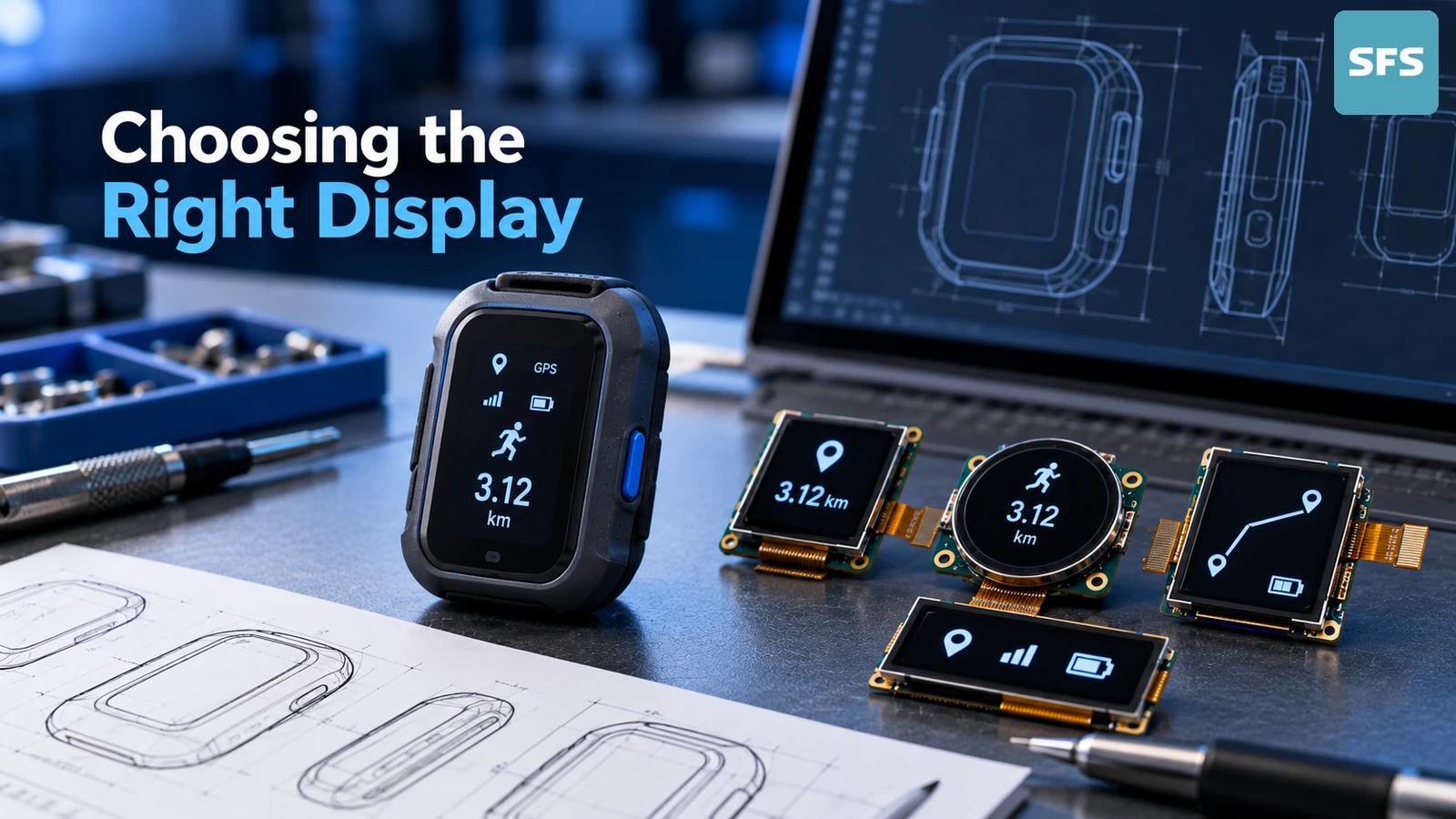
When developing a GPS tracker, most attention naturally goes to positioning accuracy, connectivity, and battery life. However, another component has a significant impact on usability and hardware design: the display.
At Sport Flow Solutions, we are developing our own wearable GPS tracker for real-time athlete tracking. Even something as seemingly simple as selecting a screen requires careful engineering evaluation.
Screen Size: Bigger Is Not Always Better
A sports GPS tracker needs to be compact, lightweight, and comfortable to wear during physical activity.
A larger display provides more space for information, but it also increases device dimensions, complicates enclosure design, and may increase power consumption.
A smaller display saves valuable space, but essential information must remain clearly visible.
Our challenge is finding the right balance between physical dimensions and the information athletes actually need.
Readability in Direct Sunlight
Unlike many consumer electronic devices, sports GPS trackers are primarily used outdoors.
Bright sunlight, cloudy conditions, rain, and constantly changing lighting conditions place specific demands on the display.
High resolution alone does not guarantee good readability.
We evaluate brightness, contrast, viewing angles, surface reflections, and backlight efficiency.
An athlete should be able to check the device status quickly, without struggling to read the screen.
Power Consumption: Every Milliamp Matters
Our GPS tracker performs several tasks simultaneously: receiving GNSS positioning data, transmitting information through LTE mobile networks, and communicating with additional devices via Bluetooth.
All these operations require energy.
The display, particularly its backlight, also consumes power. Even a relatively small increase in average consumption can affect battery life.
That is why we consider more than the display's technical specifications. Backlight control, efficient screen updates, and the ability to turn the display off are equally important.
Our priority is preserving energy for the tracker's essential functions: positioning, connectivity, and data recording.
What Does an Athlete Really Need to See?
We believe a sports GPS tracker should not become a miniature smartphone.
Its display should serve a clear purpose: communicating essential device information quickly and reliably.
This may include:
- GPS/GNSS signal status;
- mobile network connectivity;
- battery level;
- data recording and transmission status.
A simple, well-designed interface helps athletes understand what is happening without unnecessary distractions.
The Display Is Part of the Entire Hardware Design
Display selection also affects the physical construction of the tracker.
We consider dimensions, mounting methods, electrical interfaces, component placement, and mechanical reliability under vibration.
Even a display with excellent specifications may be unsuitable if it complicates the design of a compact enclosure.
This is why display selection must be considered together with PCB layout, enclosure engineering, and power management.
Our Engineering Approach
At Sport Flow Solutions, our goal is not to install the biggest or most expensive display.
We are looking for a solution that balances outdoor readability, compact dimensions, reliability, and energy efficiency.
Development is ongoing, and we continue evaluating different options before making a final decision.
A great GPS tracker is not defined by the number of features it offers, but by how effectively every component contributes to its core purpose.

Ei vielä kommentteja. Ole ensimmäinen!