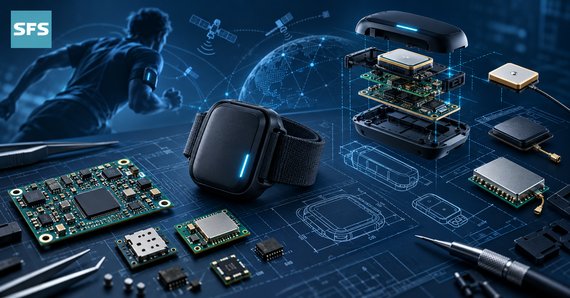
Sport Flow Solutions is not being built around an existing GPS tracker or a ready-made hardware platform.
We are developing the system from the ground up — including our own GPS/GNSS tracking device designed specifically for sports, real-time monitoring and long-term use in demanding outdoor conditions.
This is an important part of our approach.
A sports tracking system is only as reliable as the weakest component inside it. Good software cannot fully compensate for unstable GNSS reception, poor antenna placement, unreliable mobile connectivity, power problems or hardware that was never designed for continuous movement and vibration.
That is why we decided to approach the hardware as seriously as the software.
Why develop our own tracker?
There are many GPS devices on the market, but most of them were designed for other purposes.
Some are intended for vehicles. Others are designed for pets, logistics, personal safety or general asset tracking. Even sports watches are usually focused primarily on collecting data for the athlete rather than continuously transmitting it to a coach or monitoring platform in real time.
Sport Flow Solutions has a different objective.
Our tracker is intended to operate directly on an athlete during training or competition. It should continuously determine the athlete's position, transmit data to the server through a mobile network, communicate with additional sensors and remain stable while the athlete is running, cycling, skiing or moving through difficult terrain.
This changes many technical requirements.
Size matters.
Battery life matters.
GNSS accuracy matters.
Mobile connectivity matters.
Antenna placement matters.
Resistance to vibration matters.
Power stability matters.
Even the way two circuit boards are connected inside the device matters.
Instead of adapting around the limitations of a finished product, we want the hardware architecture to reflect the actual requirements of Sport Flow Solutions.
Every component is selected carefully
We are currently working on the hardware architecture and component selection for our own tracker.
The device combines several important subsystems: GNSS positioning, LTE mobile connectivity, Bluetooth, power management, local data storage, motion sensing, a display, sound and vibration feedback.
Each of these subsystems affects the others.
For example, choosing a GNSS module is not simply a question of finding a component that can calculate coordinates.
We also have to consider satellite systems, supported frequency bands, power consumption, signal quality while the athlete is moving, antenna requirements, electrical noise and physical placement inside the enclosure.
The same applies to LTE.
A modem may look suitable on paper, but the complete system also has to handle short peaks in power consumption without affecting GNSS, the processor or other components.
Antennas must be positioned so they do not interfere with each other.
The battery has to provide enough capacity while keeping the device compact and wearable.
Connectors must remain reliable during continuous movement and vibration.
Every small decision influences the final result.
We want to understand the problems before production
One of the principles behind the development of Sport Flow Solutions is that we do not only look at the advantages of a component.
We actively look for its weaknesses.
What happens when the mobile signal becomes poor?
How does the GNSS behave near trees, buildings or difficult terrain?
What happens during a sudden LTE power peak?
Can vibration loosen an internal connection?
Can electrical noise reduce positioning quality?
Does the selected component remain available from reliable suppliers?
Can it realistically be used later in serial production?
These questions are important because problems that appear small during prototyping can become major reliability issues when a device is used by real athletes.
We would rather identify those problems during development than discover them after the product reaches users.
Designed for real sports conditions
The tracker is being designed as a compact wearable device that can be mounted on an athlete.
This means the hardware cannot be evaluated only on a workbench.
The final system has to operate while the athlete is moving, accelerating, jumping, running over uneven terrain or spending long periods outdoors.
The device must also maintain reliable communication while its orientation constantly changes.
This is particularly important in sports such as orienteering, trail running, cycling, cross-country skiing, alpine skiing and other outdoor disciplines where the athlete may disappear from the coach's field of view for long periods.
In those situations, real-time tracking is not simply an additional statistic.
It can become an important part of both training analysis and athlete safety.
Hardware and software as one system
Another important reason for developing our own tracker is integration.
Sport Flow Solutions is not intended to be a collection of separate products connected together after development.
Our goal is to design the hardware, communication layer, server infrastructure and coaching interface as parts of one system.
The tracker collects the data.
The communication layer sends it.
The server processes it.
The coach sees the information in real time.
Future external devices, such as heart-rate sensors or RFID readers, can also become part of the same architecture.
When all these elements are designed together, we have much more control over reliability, power consumption, data flow and future development.
We can also optimise the system for the tasks that actually matter to athletes and coaches instead of maintaining unnecessary functions inherited from generic hardware.
Development takes time — and that is intentional
It would be possible to move faster by choosing a finished GPS tracker and building the platform around its limitations.
That is not the direction we have chosen.
Sport Flow Solutions is being developed step by step, with a strong focus on understanding the technical details behind every important decision.
We are studying datasheets, reference designs, antenna requirements, power systems, mechanical constraints and possible failure scenarios.
Some decisions are changed when we find a better solution.
Others remain open until the surrounding architecture becomes clear.
This process takes more time, but it gives us something much more valuable: understanding of the complete system.
Building the foundation
The current hardware is still under development.
There are components that have already been selected and others that will continue to be evaluated as the mechanical design, PCB layout and prototypes progress.
That is exactly how we want the project to develop.
Sport Flow Solutions is not about releasing another generic tracker as quickly as possible.
We are building the foundation for a system designed specifically around real-time sports tracking.
Our objective is simple: understand every important part of the system, identify the problems early and build hardware and software that work together from the very beginning.
That foundation is what we believe will ultimately make Sport Flow Solutions reliable in real training and competition environments.

No comments yet. Be the first!